The Nature of Horror

Horror’s surrealist and realist nature provides an audience with a source of entertainment. It also grants access for Young Adults (the main audience of the genre) to explore their fears safely. However, horror wasn’t always this way. So, let’s explore the interesting tale of the birth and growth of horror…
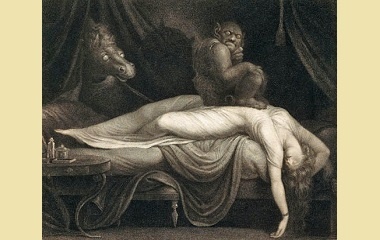
The Nightmare by Thomas Burke
© Thomas Burke, ‘The Nightmare’

From ancient mythology and folklore to polytheistic religion and cultural zeitgeist, all are fascinated by the fundamental element of horror: the nature of death, ‘the multiple ways in which it can occur, and the untimely nature of its occurrence’. Death is the ultimate fear of the unknown as no matter what after-life you chose to believe in, faith can only suggest so much. Death is the one thing even science cannot defy. This lack of acceptance towards death within society means ‘the place of the living is haunted by the dead’ hence, why ghost stories are so compelling. This feature of the genre is what makes horror so omnipresent throughout history as ‘societies are constantly having to address the things which threaten the maintenance of life and its defining practices’.

In the Megalithic period, horror was originally used in folklore as a cautionary tale to children for misbehaving. Stories symbolised ‘the aspirations, needs, dreams and wishes of the people’, which reinforced the status quo, established the normality of the era or confronted societal conventions of the time. To this day, that is a crucial purpose in horror: to be ‘socially, politically and culturally transgressive and challenging’.

Monsters and ghouls are often used as manifestations of social fears. For example, Jekyll and Hyde explored the fear that even good people have evil inside them. Likewise, serial killers like Ted Bundy and Charles Manson in 1970s America brought a message of ‘living in fear’ to their society. As a result, horror films in the 70s starred crazed killers. Therefore, the nature of horror is paradoxical.
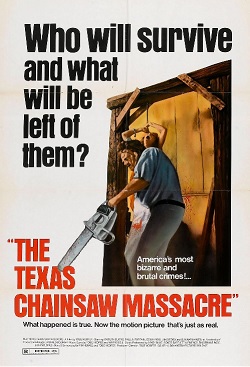
The Texas Chain Saw Massacre - Wikipedia
© New Line Cinema, 1974

Horror is ‘a construction, projection and representation’ with meaning rooted in every angle of its subject. Hence, the genre ‘acts as a vehicle for us to face up to and face down what we avoid, repress, ignore or can see no escape from’ by exploring politics, religion, sex and repression.

‘Religion is not nice; it has been responsible for more death and suffering than any other human activity’ which is why it so often appears in horror fiction as it adds danger to a narrative. Horror thrives on subverting religious good which is why there’s an argument that horror may be an organised religion. As horror explores mortality and what happens after death in the same way Christianity does. This is a reason why people are drawn to the horror genre. It is not afraid to do the outrageous and be a symbol for the unthinkable.

Horror’s foundation is the ability to stimulate an emotional state in the reader. It’s in the genre’s nature to take something normal and twist it. Sex in the genre is no longer loving or passionate, it’s horrific – it’s rape or it’s assault. Metaphors in the genre are ‘built upon the idea of a hidden, silent and repressed sexuality’. In Dracula, for instance, biting his victims could be a metaphor for reproduction. Furthermore, Dracula ‘overturns the sexual politics of the bourgeois home’ by attacking women betrothed/married. Whilst “Dollies” by Kathryn Ptacek follows the rape of an adolescent girl which could stem back to the Victorian era’s twisted approach to sex with children.

Movies: Dracula (1931) - The Greatest Literature of All Time
© Universal Pictures, 1931

Even in the literature that is not categorised as horror, the plots involve monsters that implement arousal in the reader. Shakespeare had witches; Rowling had dementors, and Tolkien had all kinds of creatures like orcs and trolls.

That is the true nature of horror.

It has been everywhere, it is everywhere and it will go everywhere. Just like our ancestors, we must too be the people that are ‘the carriers and transformers of the tales’, for as long as society lives.

WORD COUNT: (exc. Quotes) 525

Bibliography (in order of use)

Wells, Paul. The Horror Genre: From Beelzebub to Blair Witch, (London: Wallflower, 2000) page 10

Dorman, Rushton M. The origin of primitive superstitions, (London:  J.B.Lippincott & Co. 1881) page 19

Wells, Paul. The Horror Genre: From Beelzebub to Blair Witch, (London: Wallflower, 2000) page 10

Zipes, Jack. Breaking the Magic Spell: Radical Theories of Folk and Fairy Tales, (New York: Routledge, 1992) page 5

Wisker, Gina. Horror Fiction: An Introduction, (New York: Continuum, 2005) page 10

Stevenson, Robert L. Strange Case of Dr Jekyll and Mr Hyde (London: Longman, 1886)

Bergeron, Ryan. Notorious killers of the 1970s, edition.cnn.com, 2018 https://edition.cnn.com/2015/07/08/entertainment/the-seventies-the-decades-worst-killers/index.html Accessed: 01st April 2020

Wisker, Gina. Horror Fiction: An Introduction, (New York: Continuum, 2005) page 5

Wisker, Gina. Horror Fiction: An Introduction, (New York: Continuum, 2005) page 10

Smith, Jonathon Z., ‘The Devil in Mr. Jones’, Imagining Religion: From Babylon to Jonestown (USA: University of Chicago Press, 1982) page 110

Mitchell, Kate, History and Cultural Memory in Neo-Victorian Fiction (UK: Palgrave Macmillan, 2010) page 45 – 46

Stoker, Bram. Dracula, London: Penguin Classics, 2003

Jancovich, Mark. Horror (London: Batsford Ltd, 1992) page 50

Ptacek, Kathryn “Dollies” in New Fears, edited by Mark Morris, Titan Books, London, 2017 (page 29)

Zipes, Jack. Breaking the Magic Spell: Radical Theories of Folk and Fairy Tales, (New York: Routledge, 1992) page 5
The Geography of Fear: Horror and Location

‘The house and home are NOT a place for safety, horror tells us.’
– Gina Wisker

There is a taxonomy of locations in horror fiction: houses, mansions and asylums which can all create a different atmosphere depending on how the writer chooses to use setting. Some have argued that ‘setting is the monster’ as environments can restrict character’s movements and options leaving them trapped and vulnerable.

On a mundane level, location can be used to isolate the protagonist like in Stephen Gallagher’s “Shepherds’ Business” to enhance the sense of vulnerability. But it can do and be so much more than that.

So, what can location truly do in horror fiction?

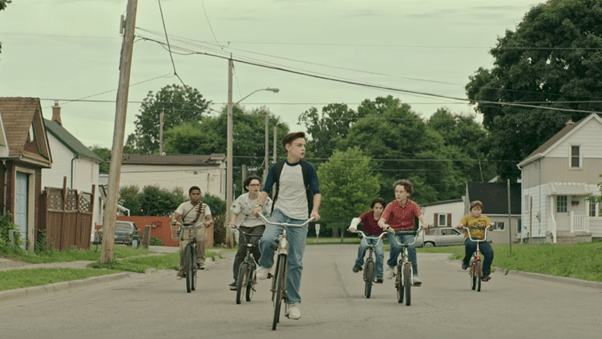
In contemporary horror, writers such as King and Kootnz explore locations close to suburban life as they implement evil where safety is expected, ‘when the ordinary is invaded by the terrifyingly extraordinary, horror happens’. The reader is then left to question the safety of their own home and environment. Therefore, writers can use location to blur the lines between reality and fiction.

© New Line Cinema, 2017

Scientifically, location is an important element within the theory of ‘the survival of the fittest’. Early humans chose environments which they felt were safe and ensured their existence as dwellings ‘play an important role in creating order, meaning and stability in our lives’. When something starts to disturb that peace, we (as a species) begin to feel unsafe. And that is what horror writers count on:

‘Natural selection has favored individuals who gravitated toward environments containing the “right” physical and psychological features and avoided those which posed a threat. Places that contain a bad mix of these features induce unpleasant feelings of dread and fear, and therefore have become important ingredients of the settings for horror fiction and films’.

Our species has maintained this psychology over time as we still gravitate to physical surroundings that make us feel protected. Hence, when location is used to put the character in danger, biological instincts cause an emotional response, such as terror and anxiety, within the reader.

Sigmund Freud theorised the Uncanny as a key horror strategy ‘the familiar is defamiliarised, the stable destabilises’ to unsettle the reader’s realities and expectations. Therefore, location can be used as a character itself as it gives writers the opportunity to directly unbalance the equilibrium of the protagonist’s life.

© Gouqi Island, Photographer Unknown

For instance, abandoned locations often arise within this genre as it is uncanny for the nature of the environment. There is a sense of eeriness to a place that was once filled with people but, is now void of human life. Our species believe themselves to be advanced – the master of nature – thus, fear strikes when nature systematically reclaims what man made. Location can, therefore, be used in horror fiction to start societal conversations and destigmatise modern concepts.

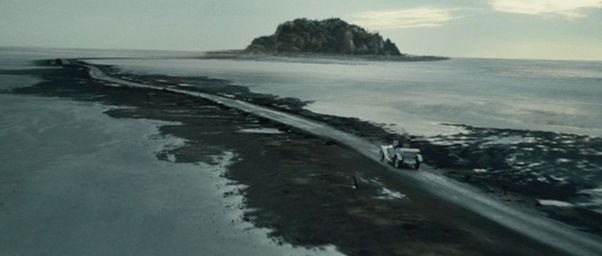
Location plays an important role in a plot as it is can be used as a device to move the action forward, ‘The spaces erupt and split, allowing in what one hoped to keep hidden, what we feared’. For example, in The Woman in Black the Causeway flooding at certain times traps Mr Kipps at Eel Marsh House allowing him to discover the secrets hidden within those four walls. Therefore, Hill’s choice of location provides her protagonist with a means to discover information.

© Hammer Film Productions, 2012

Setting can be used metaphorically or symbolically. Closed doors, attics and basements can be a metaphor for the subconscious and forgetting our past. It can be the site for trauma or a way for the protagonist to be accessed by creepy neighbours. Or setting can be a way to challenge domesticity or act as the embodiment of evil. ‘Choosing the right setting is even more important for dark stories than for most other kinds of fiction’ as it can play whatever role the writer wants it to play. Which is why any location can be a horror setting if it is described as one. You may feel safe in your house but, when the moon casts peculiar shadows whilst the curtains no longer fall straight and the floorboards in the empty attic begin to creak… it doesn’t feel so safe.

WORD COUNT (exc. Quotes): 550

Bibliography (in order of use)

Wisker, Gina. Horror Fiction: An Introduction, Continuum, New York, 2005 (page 153)

Lamson, L. Now Write! Science Fiction, Fantasy and Horror: Speculative Genre Exercises from Today’s Best Writers and Teachers. 1st ed. New York: Penguin Random House. 2014 (page 137-138)

Gallagher, Stephen. “Shepherds’ Business” in New Fears, edited by Mark Morris, Titan Books, London, 2017 (page 29)

Castle, Mort. “Reality and the Waking Nightmare: Setting and Character in Horror Fiction” in On Writing Horror, edited by Mort Castle, Ohio: Writer’s Digest, 2007 (page 85)

McAndrew, Francis T. “The Psychology, Geography, and Architecture of Horror: How Places Creep Us Out” in Evolutionary Studies in Imaginative Culture, Vol. 4.1, ESIC 4.1. 2019 (Abstract) https://www.academicstudiespress.com/asp-blog/how-places-creep-us-out

McAndrew, Francis T. “The Psychology, Geography, and Architecture of Horror: How Places Creep Us Out” in Evolutionary Studies in Imaginative Culture, Vol. 4.1, ESIC 4.1. 2019 (Abstract) https://www.academicstudiespress.com/asp-blog/how-places-creep-us-out

Wisker, Gina. Horror Fiction: An Introduction, Continuum, New York, 2005 (page 146)

Wisker, Gina. Horror Fiction: An Introduction, Continuum, New York, 2005 (page 152)

Hill, Susan. The Woman in Black, London: Vintage, 1998       

Hall, Rayne. “Writing Dark Stories”, Scimitar Press, 2014 (page 53)

The Psychology of Fear II: Horror and The Writer

‘Cowards make the best horror writers, because we know what fear feels like,’
– Rayne Hall

My previous post explored the origins of fear and my own phobias. However, I hereby suggest a universal fear that society should share: the horror writer. For decades Edgar Allan Poe, Stephen King and Dean Koontz have seeped fear into their reader’s lives through the power of words.

But, how exactly did they instil fear into their readership?

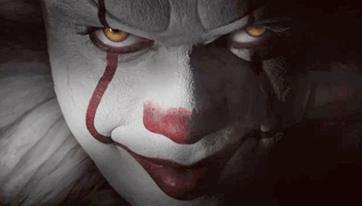
© New Line Cinema, 2017

At face value, the execution of horror fiction is like every other. It’s showered with literary devices like similes and triadic structures to present ‘the world as-it-is-being-known-and-felt’ to evoke a reaction in the reader such as unease, anxiety or empathy. For example, in “The Embarrassment of Dead Grandmothers” Lotz uses the simile ‘Its liver-spotted surface is pliant, like cheap ham’, which creates vivid imagery to make the reader feel queasy and uncomfortable as she explores the theme of death.

However, for those who truly appreciate and understand the nature of this craft, you will know it is one of the hardest genres to delve in due to its innate subjectivity. 

Poe believed he had conquered the formula for fear: ‘the isolation of the reader, the stunning of sensibility, the victimisation of emotions and the premature burial of reason’. These techniques are frequently used to create suspense within a narrative which enhances fear.

Writers use isolation within their plots through locations, the protagonist or the reader; loneliness creates unease. This simple element in horror writing is extremely active in the creation of fear as the heightened sense of vulnerability causes dread of what is yet to come.

The victimisation of emotions suggests that all sufferings of the protagonist should be felt by the reader. If a reader does not identify with the main character, the narrative falls flat. Thus, it’s a powerful tool for a writer if the reader feels like the protagonist themselves. 

The premature burial of reasons refers to writers withholding information to instil fear within their narrative. ‘The horror writer must walk a tightrope, balancing delicately between predictability and obscurity, telling neither too much nor too little’ as this creates a level of uncertainty and discomfort within the reader. Hence, ambiguity in the plot allows the writer to challenge the boundaries of reality, leaving the reader to question all that they thought was true. A wail in the house at night is no longer a pipe humming but, the presence of something far worse.

But, with the popularity of horror films and video games at an all-time high in modern society, is Poe’s formula enough?

Writers may also use their own phobias within their work to ‘achieve a level of authenticity that other writers cannot achieve’. By knowing the intended outcome, a writer can input precise lexical choices and circumstances within the plot to stir fear in their reader.

Another device intended to ignite terror is the metaphor. Fiction that represents societal fears creates terror in the reader as their worst phobias are being presented to them. As ‘Horror explores the fissures that open in our everyday lives and destabilizes our complacency about norms and rules’, the reader is lead to believe that even their sanctuary is not safe. An example of this technique is in Frankenstein. Shelley may have aimed to exaggerate the societal beliefs of bad parenting by highlighting the repercussions of an absent mother. This, therefore, spread fear amongst 1818 society.

I reiterate, the horror writer should be feared. Their work lives amongst us, breathes within us, stays with us like a shadow. Our overactive imaginations no longer know the line between real and imaginary. Once our bedroom lights are switched off, there could be anything in the room with us.

Word Count (exc. Quotes): 537

Bibliography (in order of use)

Hall, Rayne. “Writing Dark Stories”, Scimitar Press, 2014 (page 8)

Doty, Mark. The Art of Description, Minnesota: Graywolf Press, 2010 (page 49)

Lotz, Sarah. “The Embarrassment of Dead Grandmothers” in New Fears, edited by Mark Morris, Titan Books, London, 2017 (page 244)

Saliba, R.D. (1980). A Psychology of Fear: The Nightmare Formula of Edgar Allan Poe. Washington D.C: University Press of America. (page 17-18)

Taylor, D.W. “How To Write Today’s Horror” in The Craft and Business of Writing, Ohio: Writer’s Digest, 2008 (page 113)

Hall, Rayne. “Writing Dark Stories”, Scimitar Press, 2014 (page 9)

Wisker, Gina. Horror Fiction: An Introduction, Continuum, New York, 2005 (page 9)

The Psychology of Fear I: Horror and Me

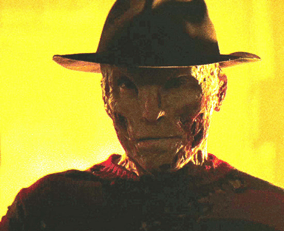
Cremated flesh upon his face, knives extending from his fingertips, a burnt striped top; the first monster that had ever scared me. For safety reasons, I stayed away from the TV whilst the film played.

© New Line Cinema, 2010

But why didn’t I want to go near the TV?

Fear is a key player within the horror genre. It tests the reader’s limits and forces them to explore the line between reality and imaginary, which is exactly what A Nightmare on Elm Street did for me. For days I wondered if a burnt man could really kill me through my dreams.

The Evolution of Fear

Fear is a biological defence mechanism that evolved to ensure the survival of our species. It is suggested that some fears are innate as they are rooted in ‘our ancestors’ primitive fear of the dark, the unknown, the inexplicable, the uncanny and supernatural’. Phobias, therefore, have a direct stimulus which can be either environmental or psychological.

Tony Hoagland proposed that ‘fear was the ghost of experience: we fear the reoccurrence of a pain we once felt’. Our biological fear of pain may, therefore, arise when an experience triggers it. That specific pain may then be kept alive through our memories to protect cognitive and physical functions.

However, fear can also be learnt. Ivan Pavlov theorised classical conditioning; the process of learning by association. In 1920, Watson and Raynor created a phobia in a 9-month-old baby, Little Albert, who associated animals (conditioned stimulus) with a loud bang and so, became scared of furry things (conditioned response). 

The Horror Genre

So, if fear is a negative arousal, why is horrifying media so successful?

At ten-years-old, reading the Demonata series by Darren Shan was thrilling. I was able to explore boundaries of knowledge and reality through fictional settings and creatures. My body was safe whilst my mind was pleasantly tormented.

Glenn Sparks suggests the excitation transfer process; physiological arousal loiters after a film is finished. Zillmann et al’s 1986 study found that ‘when males viewed a horror film, their levels of reported distress were correlated with levels of enjoyment or delight’. Therefore, any positive emotion felt throughout an experience – for example, enjoying time with friends – is dominant over the negative reactions. So, a person is driven to find those excitements again.

My Fears

With no intent of bravado, as an adult I have established few new fears. Stories such as The Family Car are riddled with plot improvements, not horror. However, some phobias have stalked me since childhood.

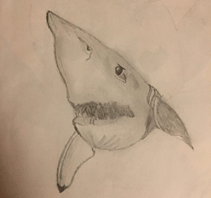
At seven-years-old, I descended into a two-week darkness. Every sleep was cursed with the nightmare of a shark devouring my family. Jaws ripping the banana boat into shreds haunted me. As a child, I cried every time my dad left the sand and ventured into the deep, fearing he would never return to me. As an adult, the notion of a banana boat continues to terrify me. If I wade in the water, one eye is always alert.

Drawing by me

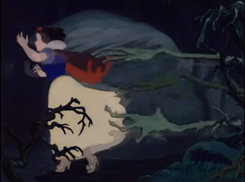
Creatures playing evil games; nature whispering and plotting. At twenty-years-old, the wound of Snow White and The Seven Dwarfs is still open. The vulnerability, the weakness, lost in blindness. A dark forest with only slithers of moonlight to guide you. A fear rooted deep within this film – I have never welcomed the outdoors at night since.

© Walt Disney Productions, 1937

Throughout our prepubescent years one’s psychology is still developing. Hence, children are more susceptible to horrifying media and fears are more likely to transcend into adulthood (as mine have).

Furthermore, the emotions I feel in the presence of my phobia’s stimuli is what I aim to embed and evoke in my writing within the horror genre.

‘Horror is both an everyday occurrence – terrorism, the cannibal next door, torture – and a way of dramatizing our hidden fears and desires’ – Gina Wisker

WORD COUNT (exc. Quotes): 530

Bibliography (in order of use):

A Nightmare on Elm Street, Directed by Samuel Bayer, New Line Cinema, Platinum Dunes, 2010, Film

Wisker, Gina. Horror Fiction: An Introduction, Continuum, New York, 2005 (page 2)

Ruefle, Mary. “On Fear.” Poetry 200, no. 3 (2012): 277-90. Accessed January 26, 2020. www.jstor.org/stable/23249422.

Shan, Darren. The Demonata Series, Harper Collins, London, (2005-2010)

Sparks, Glenn G. “The Relationship Between Distress and Delight in Males’ and Females’ Reactions to Frightening Films”, Human Communication Research, Volume 17, Issue 4, June 1991, Pages 625-637, https://doi.org/10.1111/j.1468-2958.1991.tb00247.x

Golden, Brady. “The Family Car” in New Fears, edited by Mark Morris, Titan Books, London, 2017 (page 75)

Jaws, Directed by Steven Spielberg, Universal Pictures, 1975, Film

Snow White and The Seven Dwarves, Directed by David Hand and William Cottrell, Walt Disney Productions, 1937, Film

Wisker, Gina. Horror Fiction: An Introduction, Continuum, New York, 2005 (page 1)

Design a site like this with WordPress.com
Get started