Cremated flesh upon his face, knives extending from his fingertips, a burnt striped top; the first monster that had ever scared me. For safety reasons, I stayed away from the TV whilst the film played.
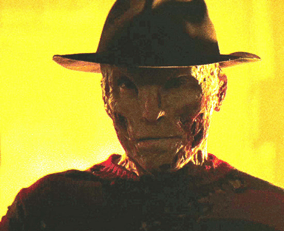
But why didn’t I want to go near the TV?
Fear is a key player within the horror genre. It tests the reader’s limits and forces them to explore the line between reality and imaginary, which is exactly what A Nightmare on Elm Street did for me. For days I wondered if a burnt man could really kill me through my dreams.
The Evolution of Fear
Fear is a biological defence mechanism that evolved to ensure the survival of our species. It is suggested that some fears are innate as they are rooted in ‘our ancestors’ primitive fear of the dark, the unknown, the inexplicable, the uncanny and supernatural’. Phobias, therefore, have a direct stimulus which can be either environmental or psychological.
Tony Hoagland proposed that ‘fear was the ghost of experience: we fear the reoccurrence of a pain we once felt’. Our biological fear of pain may, therefore, arise when an experience triggers it. That specific pain may then be kept alive through our memories to protect cognitive and physical functions.
However, fear can also be learnt. Ivan Pavlov theorised classical conditioning; the process of learning by association. In 1920, Watson and Raynor created a phobia in a 9-month-old baby, Little Albert, who associated animals (conditioned stimulus) with a loud bang and so, became scared of furry things (conditioned response).
The Horror Genre
So, if fear is a negative arousal, why is horrifying media so successful?
At ten-years-old, reading the Demonata series by Darren Shan was thrilling. I was able to explore boundaries of knowledge and reality through fictional settings and creatures. My body was safe whilst my mind was pleasantly tormented.
Glenn Sparks suggests the excitation transfer process; physiological arousal loiters after a film is finished. Zillmann et al’s 1986 study found that ‘when males viewed a horror film, their levels of reported distress were correlated with levels of enjoyment or delight’. Therefore, any positive emotion felt throughout an experience – for example, enjoying time with friends – is dominant over the negative reactions. So, a person is driven to find those excitements again.
My Fears
With no intent of bravado, as an adult I have established few new fears. Stories such as The Family Car are riddled with plot improvements, not horror. However, some phobias have stalked me since childhood.
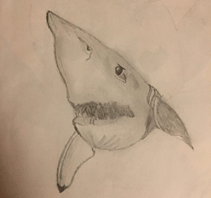
At seven-years-old, I descended into a two-week darkness. Every sleep was cursed with the nightmare of a shark devouring my family. Jaws ripping the banana boat into shreds haunted me. As a child, I cried every time my dad left the sand and ventured into the deep, fearing he would never return to me. As an adult, the notion of a banana boat continues to terrify me. If I wade in the water, one eye is always alert.
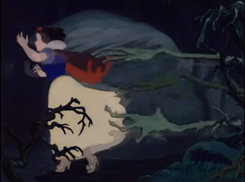
Creatures playing evil games; nature whispering and plotting. At twenty-years-old, the wound of Snow White and The Seven Dwarfs is still open. The vulnerability, the weakness, lost in blindness. A dark forest with only slithers of moonlight to guide you. A fear rooted deep within this film – I have never welcomed the outdoors at night since.
Throughout our prepubescent years one’s psychology is still developing. Hence, children are more susceptible to horrifying media and fears are more likely to transcend into adulthood (as mine have).
Furthermore, the emotions I feel in the presence of my phobia’s stimuli is what I aim to embed and evoke in my writing within the horror genre.
‘Horror is both an everyday occurrence – terrorism, the cannibal next door, torture – and a way of dramatizing our hidden fears and desires’ – Gina Wisker
WORD COUNT (exc. Quotes): 530
Bibliography (in order of use):
A Nightmare on Elm Street, Directed by Samuel Bayer, New Line Cinema, Platinum Dunes, 2010, Film
Wisker, Gina. Horror Fiction: An Introduction, Continuum, New York, 2005 (page 2)
Ruefle, Mary. “On Fear.” Poetry 200, no. 3 (2012): 277-90. Accessed January 26, 2020. www.jstor.org/stable/23249422.
Shan, Darren. The Demonata Series, Harper Collins, London, (2005-2010)
Sparks, Glenn G. “The Relationship Between Distress and Delight in Males’ and Females’ Reactions to Frightening Films”, Human Communication Research, Volume 17, Issue 4, June 1991, Pages 625-637, https://doi.org/10.1111/j.1468-2958.1991.tb00247.x
Golden, Brady. “The Family Car” in New Fears, edited by Mark Morris, Titan Books, London, 2017 (page 75)
Jaws, Directed by Steven Spielberg, Universal Pictures, 1975, Film
Snow White and The Seven Dwarves, Directed by David Hand and William Cottrell, Walt Disney Productions, 1937, Film
Wisker, Gina. Horror Fiction: An Introduction, Continuum, New York, 2005 (page 1)
 Frightmare Fiction